
On July 1 of this year I had a name, a drawer of old bylines, and nothing a reader could find. No site. No brand system. Nothing that could be called a readership. I was at the kitchen table after the kids went down, in front of a terminal I had only just learned how to open. The honest feeling was that I was twenty years late to my own work.
Eleven weeks later there is a site at josephlapin.com, launched August 5. There is a Sunday essay called The Human in the Loop, numbered to No. 8, seven of them sent. There are forty posts on the blog, nine interview profiles, four reader polls, a comic with twenty-five strips, a wedding film cut out of 499 photographs, and a birthday film for a five-year-old. All of it went up on nights and weekends, around a company and three kids, by one person who has never written a line of code for a living.
I want to be careful about what that sentence claims. It is not a story about a tool being fast. The tool is fast. That part is the least interesting part, and if fast were enough, the internet would be full of good brands instead of full of the ones we all scroll past.
It is a story about placement. Somewhere in every one of those weeks, the machine came to a stop and waited for a person, and I decided who that person was going to be. There are five of those places. I put myself in all five on purpose, in an order that turned out to matter. Everything downstream of them runs better than anything I built in twenty years of waiting on a quarter’s budget.
Before I get to the five, one question I have started asking every room I walk into. Rate your own ability with AI, one to five. Drop the number in the chat. I have asked marketers, students, founders, and agency people who have built automation systems for other companies. Every room lands on three. A 3.2 here, a 3.5 there, one woman who gave herself a 3.9 and then spent thirty seconds explaining why she did not deserve a four. Nobody feels like a five.
Hold your number. I will come back to it at the end.
The thirty-second answer
✶ The thirty-second answer
Put a person in on purpose, at five points: the folder, the voice, the look, the gates, and the loops. The machine will fill any of those five with the average of the internet if you let it, and the result will be competent and anonymous. The folder is what the brand stands for, written down where a model reads it first. The voice is what it sounds like, built from your own sentences instead of adjectives. The look is your taste, in a form a machine can use. The gates are your standards, enforced by something that cannot get tired. The loops are the work that runs while you are at your kid’s practice. Build them in that order, because each one is what makes the next one safe.
The part nobody tells you: the whole thing took under twelve weeks of evenings, and the expensive ingredient was never the tool. It was the twenty years of taste I already had and had never written down.
What it looks like with no human in it
The first landing page the machine ever made me is a page I now keep around on purpose. Purple gradient headline. A promise about reaching your full potential with innovative solutions. Three feature cards with emoji on them. A hero illustration of a floating hexagon.

The first landing page the machine made me, reconstructed. No folder, no board, no voice guide. It is the average of the internet.
When I show it to a room, people laugh, and then they stop laughing, because they recognize it. They have been served that exact page a hundred times this year. So I ask whose page it is. It is nobody’s. It has no company in it, no person, no argument, no reason to exist. It is the average of the internet, rendered in about four seconds.
Nothing was wrong with the machine. I had given it no folder, no board, no voice guide, no sentence I had ever actually written. It knew nothing true about me, so it did the only honest thing available and handed back the mean of everything it had ever read.
That page is the control group for this entire guide. Everything in the five steps is me telling it something true, and then checking whether it listened.
Before step 1: the brand is a document
The thing that came before the folder was a document, and it was slow, and no machine wrote a word of it.
Over the last week of July I sat down and argued with myself on paper until there was a brand stack: six parts, dated July 31, 2026. Part one is the shared foundation, the layer above the brand. Part two is the strategy, where I talked myself out of calling myself a writer first. Part three is the palette, sampled off one illustration I loved. Part four is the ecosystem. Parts five and six are the surfaces and the plan.
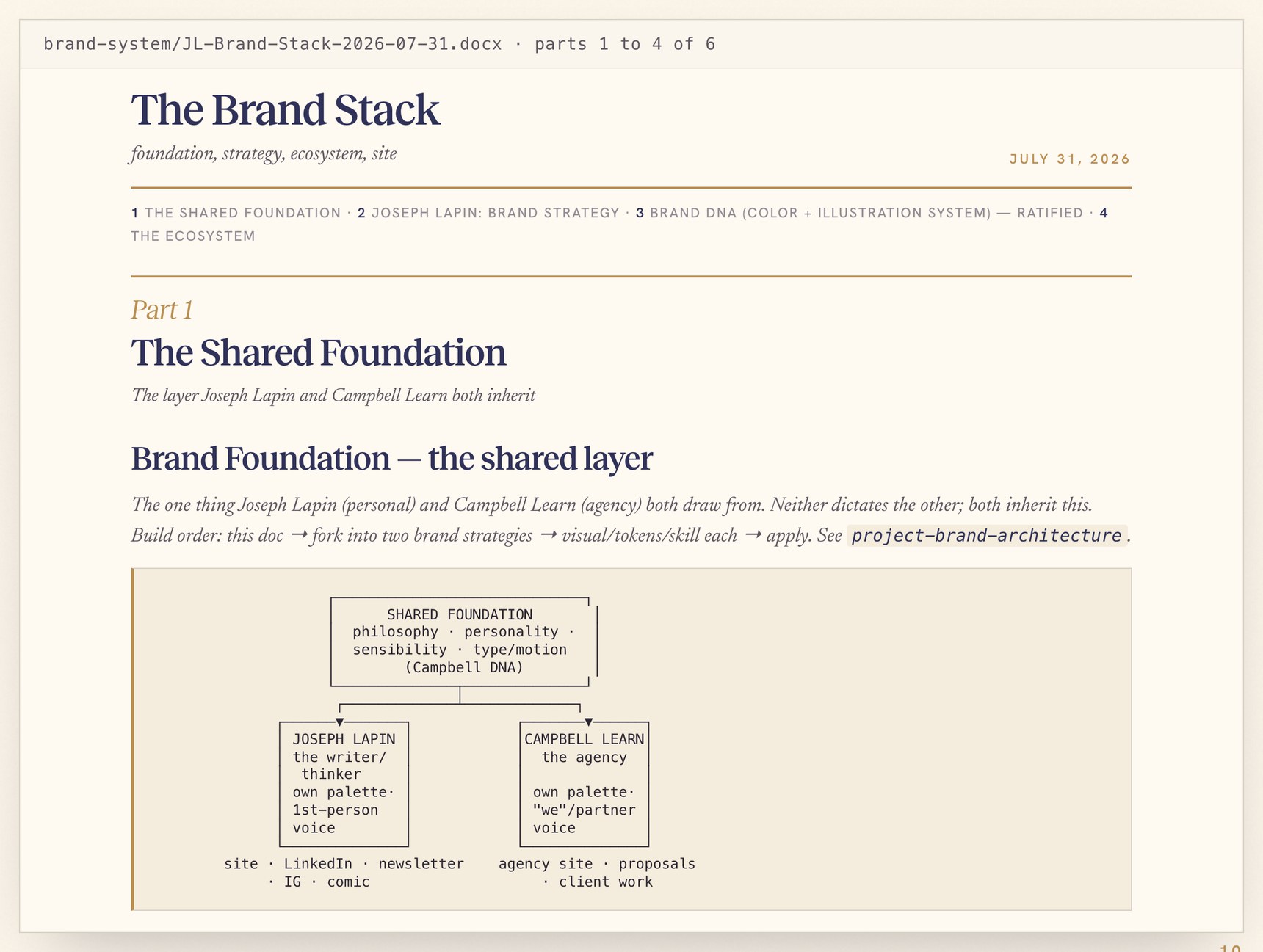
The Brand Stack, as I scroll it in the talk. Part 1 is the shared foundation; the graph forks it into Joseph Lapin and Campbell Learn.
Part one matters most, and it matters for a reason that only shows up later. I have more than one thing with my name near it. There is a personal brand, there is an agency, and I am a co-founder of FirstLight Ventures, an applied-AI firm. For a while I tried to write separate identities for each, and they drifted apart in ways that felt wrong, because they come out of the same person and the same idea. So I wrote one file that sits above all of them. Origin, three beliefs, a personality, a design sensibility. Each brand inherits it. None of them dictates the others. The agency speaks as “we.” My own name speaks in the first person. The graph forks at the top and never has to be re-argued.
The origin in that file is Joseph Campbell’s monomyth, which is in my name and in the agency’s, and which I have used as a story spine for two decades. A note for the record: I have no affiliation with the Joseph Campbell Foundation. Campbell’s work is an inspiration to me, nothing more, and none of this is endorsed by anyone but me.
Part four, the ecosystem, is the part most people skip and then regret. It is a hub and six wings. The hub is the site. The wings are the agency, the venture, the comic, the Sunday essay, the writing archive, and LinkedIn, which is the one arrow that points in rather than out. The hub is not a portfolio and it is not a funnel. Its job is legibility and routing: make it obvious that these are one mind, then send each reader to whichever door they actually wanted.
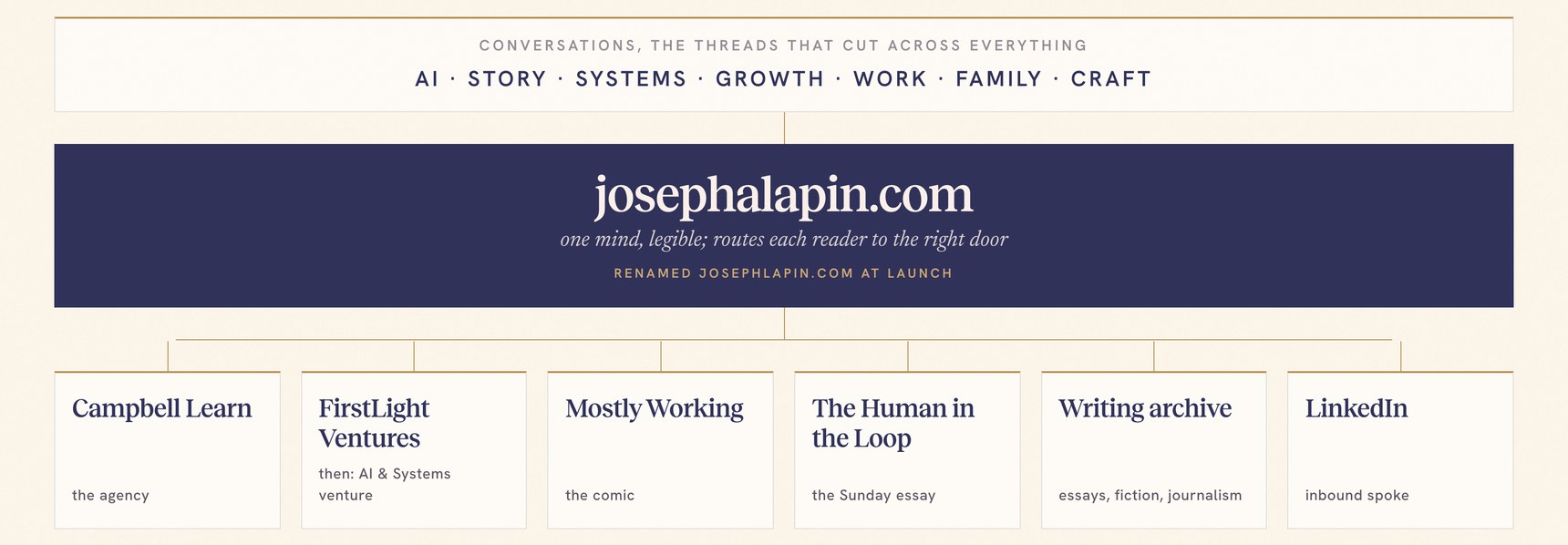
Part 4, drawn out. The conversations cut across everything; the hub routes each reader to a wing. The venture in the middle became FirstLight Ventures.
One brand document. Three businesses. One mind. Every call the machine made in the eleven weeks after traces back to a line in that file, which is the only reason a machine could make those calls at all.
If you want the long version of how a document becomes a set of files a model can read, I wrote it up separately in The Folder Is the Brand. Everything below assumes the document exists.

The five places, in the order they happened. Each one is a real file on my machine, and each one has a moment where the machine stopped and I decided.
Step 1. The folder
What I told it. I opened Claude Code inside an empty folder and told it who I was. Not a prompt. A memo.
The file is called CLAUDE.md, it sits at the top of the folder, and the model reads it before anything else, every session, without being asked. Mine says what this is, who it is for, and the rules that cannot be broken. Above it sits the foundation file, which would still be true if the brand changed its name tomorrow. Under it sit the brand system, the site, the content, and a folder of skills I will get to in step four.
What it did. It proposed a structure, wrote first drafts of most of the files, and then started behaving differently. A model with a folder underneath it stops guessing. Ask it for a headline and it reaches for the palette and the voice rules instead of for the average of the internet.

The folder, as it stands. The stack sits at the top; the machine reads it before anything else.
Where I decided. What the thing stands for. That call was mine and no prompt could have made it. I have watched people try to shortcut this by asking a model to write their brand strategy, and what comes back is always plausible and always somebody else’s. The model can hold your identity beautifully. It cannot go get it for you.
The practical version, if you want one sentence: every layer gets one obvious home and one source of truth, and when something changes you change it in one place and the rest follows.
Step 2. The voice
What I told it. Here are twenty years of my sentences. Read them. Tell me what I sound like.
Never adjectives. I have sat in enough brand workshops to know what happens when you describe a voice with words like “authentic” and “approachable,” which is that you get a document nobody can act on. So I pointed the machine at the actual clips, the essays, the journalism, the LinkedIn posts that worked and the ones that died, and asked it to write the register down from the evidence.
What it did. It drafted a voice guide. The first draft made “writer” the master noun and hung every other identity off it as a modifier. I rejected it. The second draft tried the same construction with the order reversed, and I rejected that too. The rejection is the most useful thing in the file, because the argument I was having was never about word order. No identity in that list gets to subordinate the others. I am a writer and a builder and a founder and a father, at once, and the containing noun is human. That is why the Sunday essay is called The Human in the Loop.

The register, as the machine reads it. The banned list is where the taste lives.
Where I decided. The list of things I will not say. Here is the actual line from the file, quoted as the file has it:
Banned: empower · leverage · unlock · journey · game-changer · streamline · seamless.
Every writer has a list like that, and the list is where the taste lives. Anyone can write the positive half of a voice guide. The negative half is the part that has your fingerprints on it, because it is made entirely of things you have watched go wrong.
Three more rules came out of that session and have governed every draft since. The containing noun is human, so no identity gets stacked on top of another one. AI-native optimism, which means the machines are an invitation here and never the antagonist, because I am the person in the loop and I like it in here. And everyday life is the material: the kids’ drum set, my grandfather’s Kodak carousel, turning forty. A piece that is all idea and no person is missing the signature.
A student can write this document for themselves tonight in twenty minutes, and it will be more valuable than any prompt they will ever be handed.
Step 3. The look
What I told it. Here is what I like to look at, and here is why.
This is the step the analytical people resist and the step that pays the most. The uncomfortable question I ask rooms is this: you can look at a generated ad and say “that’s garbage,” so your eye works. Have you taught the machine what your eye knows? Almost nobody has. We expect a model to have our taste without ever showing it our taste, and then we call the output slop.
The fix is old-fashioned. Mood boards. Museums. Screenshots of anything that stops my thumb, each with a sentence about why it stopped me. Mine lives as a running visual library the machine maintains for me, which means a style I had never heard of a year ago is now vocabulary I can use in a sentence. All art is theft with a point of view. What changed is the distance between seeing something and using it.
What it did. It rendered, and rendered, and rendered. The homepage took roughly three hundred versions before one felt like mine. The illustrated figure who stands in for me took eighteen attempts before I accepted the likeness. I needed to see him from enough angles to trust him as a style rather than a lucky frame. On August 1 I retired the entire July illustration system, which I had loved a week earlier, for a pen-and-ink crosshatch hero that finally looked like the inside of my head.
Where I decided. Every single one of those cuts. There is a twenty-four second film of that process at josephlapin.com/making. The finished homepage, then the three hundred versions it beat, then the two threads running underneath it, the language and the figure.
Twenty-four seconds of the three hundred versions. The whole homepage, then the language thread, then the figure. The human was in every frame.
Three hundred versions sounds like an unreasonable amount of work. It was. Once. Now every project in this folder starts from my taste instead of from zero, and the cost of the next hero is one evening. The longer argument about taste as a thing you can train is in my guide on context and taste.

Step 4. The gates
What I told it. These are my standards. Now make them impossible to skip.
Here is the expensive lesson that produced this step. A client kept flagging the same machine cadence in our copy, the little it’s not this, it’s that pivot that models love and people do not write. Five times in two months. Each time I wrote a note in memory, and each time the tell came back, because memory loads by relevance and can be quietly skipped on a busy afternoon.
What it did. Nothing, until I changed the shape of the instruction. A note is advice. A skill is a standard, loaded every session, and a script is a wall. Seven skills live in this brand’s folder now. One catalogs every LinkedIn post so it can be repurposed later. One builds the whole weekly promo package from the latest piece. One is a literary editor for the fiction and the memoir, and it is under standing orders to edit and never to ghostwrite. One resends an issue to a single reader who found it in spam.

A skill is a standard the machine has to clear. Refuses, requires, checks. A hard hit blocks the file.
Underneath them sit two things that actually refuse. A linter reads every draft for the machine’s tells and blocks the file on a hard hit: the antithesis pivot, stacked triads, any word on the banned list, art from the retired July system. And since September 19, the publish script refuses to ship an interview profile missing from the star chart on the site. I shipped one that way once and had to go back and fix it by hand.
Where I decided. What counts as good, in writing, before anything is at stake. That is the whole job of this step. This is also the line between people who use AI and people who run it: your standards, written down, enforced by something that cannot be tired or in a hurry. I made the case for skills as gates at more length in the director’s seat guide.
Step 5. The loops
What I told it. Here is the work I do the same way every week. Take it.
What it did. Sunday, a pipeline turns a markdown file into a designed draft in Kit, art and all, ready for me to read. Monday, the promo kit turns that essay into a week of posts, a reel, and a talk-to-camera script, all of it staged for review. Every hour on the five, a publish queue running on GitHub Actions checks for anything I have signed off and ships it. On a Saturday afternoon a post I approved on Wednesday goes live at 2pm while I am at a birthday party.

What runs without me, by day. Transport and clockwork. Anything with my name on it, or someone else’s, stays with me.
Where I decided. This is the step people picture when they hear “AI marketing,” and it is deliberately last, because everything before it is what makes it safe to run. The rule I settled on for what runs alone is transport and clockwork: laying out a draft, cutting a reel, pushing a signed-off post at the hour. The rule for where I stay is anything with my name on it, and anything with someone else’s.
So: I write every Sunday essay myself. The machine lays it out. It has never written one and it is not going to. And no interview profile goes live until the person in it has read it and said yes. That one is enforced rather than intended: the queue will not move a profile the chart does not know about.
The agents at full size
The five steps are the method. Here is what they look like running, at the size I actually work at. Three pipelines, same grammar every time: an agent, a file it makes, a person decides.
The Constellation is an interview series on the site. One recorded call goes in, taken on my phone through a meeting recorder. Four agents work on it. One pulls the transcript into the folder on a single message. One drafts the profile under craft rules I wrote by hand. One draws the person in the house ink style from their own headshot. One builds the page, the node on the star chart, the sitemap entry, and the feed. Six files come out, because a profile is also a gift document for the subject, a teaser for the Sunday essay, a post in their voice, and a thank-you note.
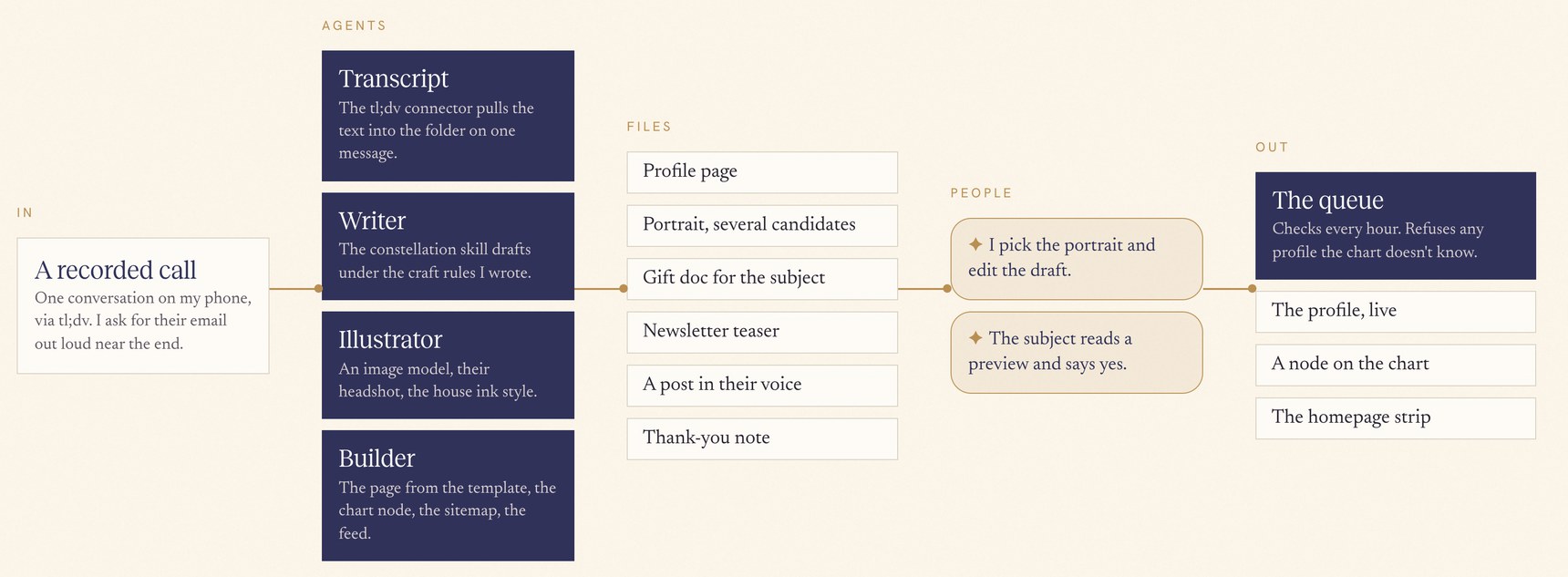
The Constellation, left to right. Navy is an agent, cream is a file it makes, gold is a person deciding.
Then the two places where it stops. I pick the portrait and edit the draft. The subject reads a preview and says yes. Only then does the queue ship it to the page, the chart, and the homepage strip. A profile is an evening’s work, and most of the evening is the call, which is the part I would never give away.
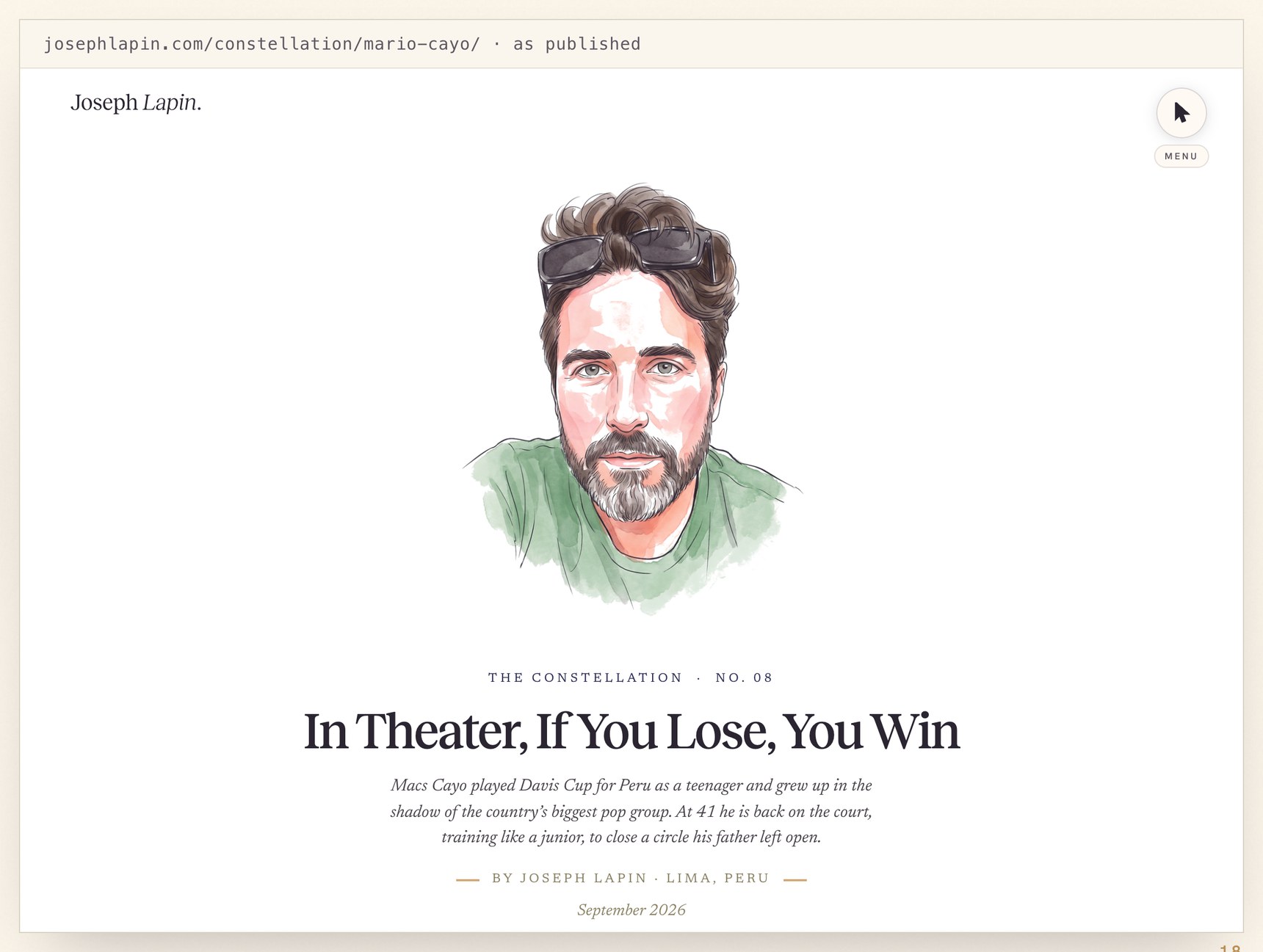
What came out: No. 08, exactly as it shipped. Nothing here looks generated, because the taste and the gates were set before the agents ran.
Mostly Working is my comic, and it runs the same shape with different parts. I write every strip. No model writes a joke here, and that is the one rule of the wing. An image model draws the cast from a character sheet so the four of them look like themselves every time. One script reads a JSON file and writes the whole section: every page, the index by subject, the crops, the share images. A previewer builds the entire section as a draft so I can read it before anything ships. I read it, and if the drawing killed the punchline, the strip goes back.
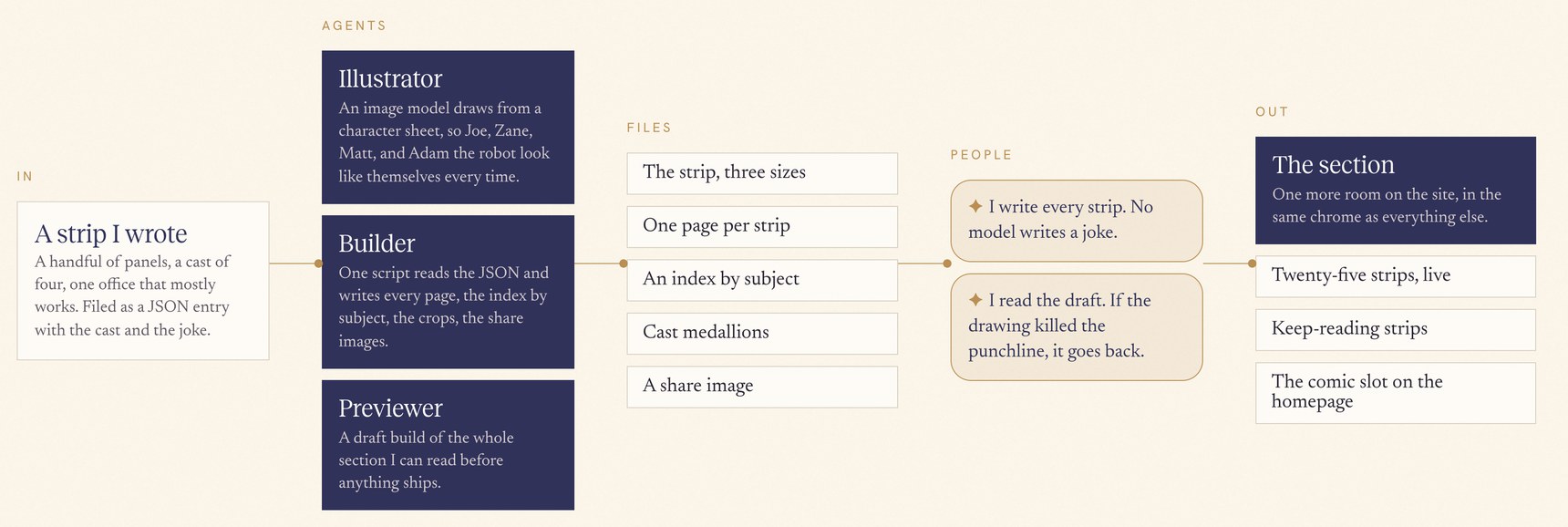
Same grammar, a comic instead of a person. I write every strip; I read every draft build.
A paid campaign is the one most marketers will actually be asked to do, so let me describe the shape without the client in it. A campaign starts as a pile: call transcripts, a messaging framework, the creative that already got approved, the brand folder. One agent reads all of it and hands back a single build brief, which means my attention goes to the work instead of to the reading. A copywriter agent drafts under one rule worth stealing: every headline has to trace to a line a real person actually said, quoted from a source in the pack. A designer agent renders each concept as a feed square and a story, from the format families that already performed. A builder agent makes the landing page from the design system, wires the form, fires the events, and checks it at phone width.
Out of one pass: sixteen concepts, a copy bank, a creative brief, a live page, a review gallery, and a pass-or-fail report. Then me, editing every line. Then the client, approving in the gallery before anything runs. Then a gate that does the boring mechanical checks, banned words and broken links and placeholder text, and reports rather than fixes, because a machine that silently repairs its own homework teaches you nothing. The numbers come back weekly and go into the next brief.
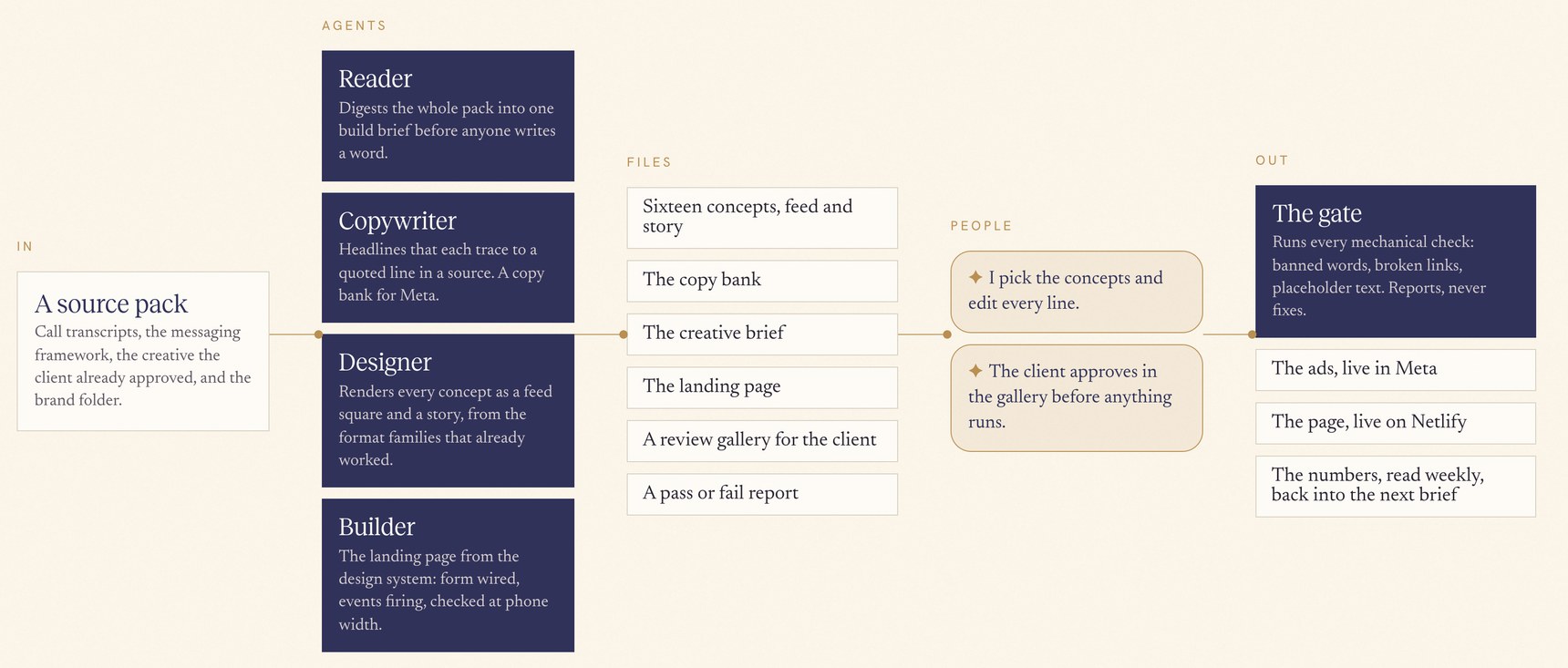
A campaign, same shape. The gate runs the mechanical checks before anything goes live; the numbers come back into the next brief.
Three pipelines, three different subjects, one grammar. A person at the start, a person at the gate, agents in between. If you are building your first one, copy the grammar and fill in your own nouns. The content-stack version of this, tool by tool, is in My AI Content Stack.
What eleven weeks produced
One person. Nights and weekends. July 1 to September 21 is eleven weeks and five days.
- July 31. The brand system seeded: palette, foundation, the folder.
- August 1. The hero locked, eighteen attempts in. The whole July system retired.
- August 5. josephlapin.com launched with the watching-the-loop masthead.
- August 9. Essay No. 1 went out, about a garden I could not build in time.
- August 27. Reader polls live, one click from the email, tallied on the site.
- September 16. The publish queue armed. The site ships on a schedule now.
- September 19. The star-chart gate landed. A profile cannot go live without its node.
- September 20. Essay No. 8.
On the board today: 40 blog posts. 9 interview profiles, 8 of real people and one invented, labeled as fiction on its own page. 4 reader polls, 25 comic strips, 2 films, and a brand system a machine can read. I counted the folders on disk this morning rather than trusting my own memory of them.
The shape of that curve is the argument. The first month is almost entirely infrastructure and taste, and it looks like nothing is happening. The output arrives after, fast, because the folder and the voice and the look and the gates were already sitting there. The machine did not get better in September. I did, because the loops finally had something worth running on.
The honest part
“From zero” was true of the infrastructure. It was not true of me, and I would rather say so plainly than let the timeline imply otherwise.
Twenty years of writing went into that folder before the machine read a word of it. Two decades of failed drafts, killed darlings, magazine editors who cut my favorite paragraph and were right to. Every hex value in the palette came off an illustration I loved for reasons I could explain. The banned-word list is made of specific afternoons. None of that was generated. All of it was deposited, slowly, at a cost, by a person who had no idea he was building a training set.
That is the part I want students to hear, because the blank terminal is a liar. It makes you feel like you are starting at nothing, and you are not. Whatever you have already made, whatever you already love to look at, whatever you refuse to say: that is your folder. The human you put in the loop is the one you already are.
Your first evening
Here is the whole thing, small enough to do tonight, in under an hour.
- Install Claude Code. One line in a terminal. The free tier is enough to do everything below.
- Make a folder named after you. Call it me. Open Claude Code inside it.
- Have it interview you for twenty minutes. Ask for two files back, voice.md and taste.md. Read them. Correct them. That correction is your first gate.
- Ask it to build a one-page site from those two files and put it on Netlify.
The install is this:
And the prompt for step three, which is the only one I would hand anyone verbatim:
That last clause is doing real work. Left alone, a model will tell you your writing is vivid and your taste is sophisticated, and you will learn nothing. Ask it to quote you and it has to go back to your actual sentences, and what comes back will be recognizable and slightly uncomfortable, which is how you know it is yours.
When something breaks, and something will, ask it why. Last month, in a room of marketers, two people hit “command not found” on the install. One of them pasted the error into her Claude, read what it told her, and thirty seconds later said “now it’s working.” She debugged a developer tool without being a developer, by staying in the conversation. That is the skill. There is no other one hiding behind it.
If you want the version of this argument aimed at a whole company’s context rather than one person’s, it is in The Company Is the Context.
The human in the loop is a design decision
Nobody ends up in the loop. There is no version of this where you use the tools for a year and gradually discover yourself at the center of the system. The center is a seat, and it stays empty, and the machine will fill it with the average of the internet on the first afternoon you let it.
You put yourself there. At the folder, so it knows what the thing stands for. At the voice, so every draft sounds like a person. At the look, so the output has an eye behind it. At the gates, so your standard survives a tired Thursday. At the loops, so the thing that runs while you sleep is running on something you chose.
Five places. All of them available tonight, in a folder on your own laptop, for free.
Now go back to the number you gave yourself at the start. Mine was a three for most of this year, and I was wrong about why. The gap between three and five was never the tool, and it was never the prompt. It was whether I had bothered to write down the person I already was, somewhere a machine could find it.
You are closer to five than you think.
Questions I get asked
What does "human in the loop" actually mean here?
It means a placement, and you choose where. In this system there are five: the folder, where a person decides what the thing stands for; the voice, where a person decides what it sounds like and what it will never say; the look, where a person decides what good looks like; the gates, where a person writes the standard down and a script enforces it; and the loops, where a person decides what is allowed to run unattended. Leave any of the five empty and the machine fills it with the average of the internet.
Do you need to know how to code to build a brand this way?
No. I have never written a line of code for a living. The tool is Claude Code, which is a terminal you talk to in plain sentences, and the free tier is enough for everything in the first-evening section of this guide. The one skill that matters is the willingness to ask it why when something breaks, and to keep asking until it works.
How long did josephlapin.com actually take?
July 1 to September 21, 2026, which is eleven weeks and five days, on nights and weekends around a company and three kids. The first month was almost entirely the brand document, the folder, the voice, and the look, and it looked like nothing was happening. The output came after, fast, because the loops finally had something worth running on.
What goes in the brand document?
Mine is six parts, dated and written by hand over the last week of July: the shared foundation that sits above every brand I own, the strategy, the palette sampled off one illustration, the ecosystem graph, the surfaces, and the plan. The foundation matters most, because it is the layer that would still be true if the brand changed its name. No machine wrote any of it.
What parts of this run without you?
Transport and clockwork. A pipeline lays out the Sunday essay as a designed draft. A promo kit turns that essay into a week of posts and a reel, staged for review. An hourly queue on GitHub Actions ships anything already signed off, including on a Saturday afternoon. What never runs alone: anything with my name on it, and anything with someone else's. I write every essay, and no interview profile goes live until the person in it has read it and said yes.
Where should someone start tonight?
Install Claude Code, make a folder named after you, and ask it to interview you for twenty minutes about how you write, what you have made, and what you like to look at. Have it write voice.md and taste.md from your answers and tell it to quote you rather than flatter you. Read both files, correct them, and then ask for a one-page site built from them. That correction is your first gate, and it is under an hour of work.
— Joe
