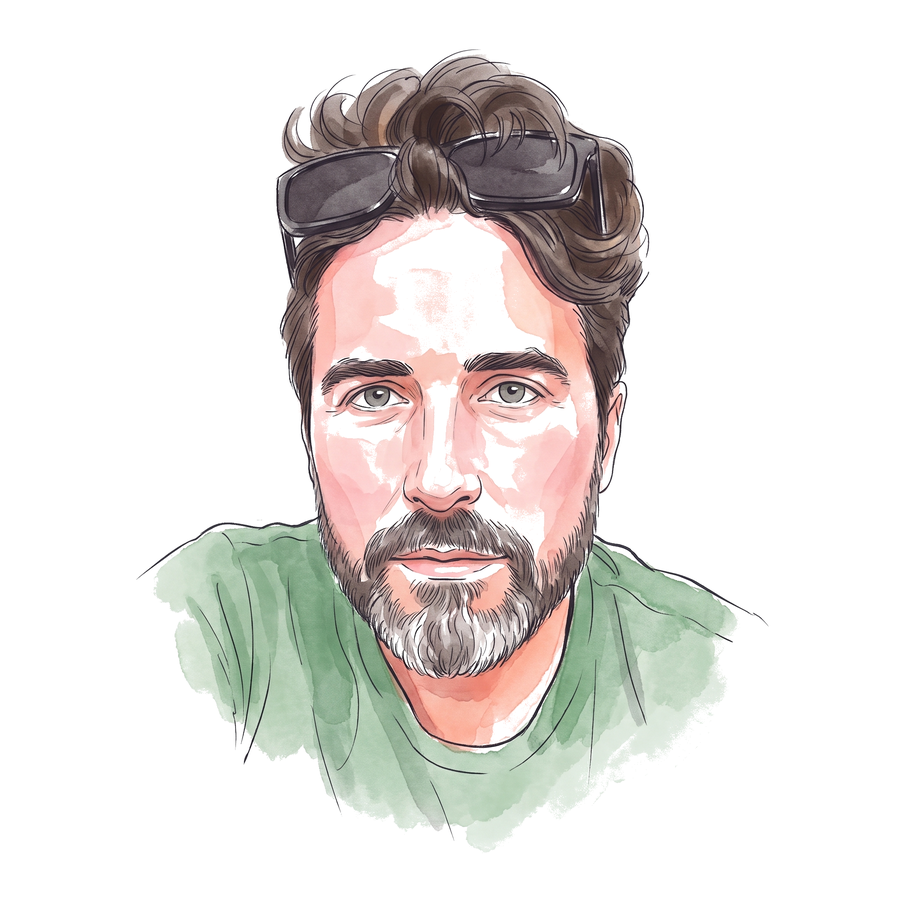
Mario Cayo is between tennis sessions when he calls, sunglasses pushed up into his hair, a green T-shirt, the Lima afternoon behind him. He is forty-one. He is training like a junior again, with conditioning and a tournament schedule and an injury he is playing through, and the first thing he wants to talk about is the sport he walked away from thirteen years ago.
“I’m filling my day with tennis,” he says. “With a new brain. An older brain.”
The world knows him as Macs, the initials a Stetson University tennis coach gave Mario Alberto Cayo Sanguineti because the whole name was too long. I have called him Mario since we met at Stetson two decades ago, when he was the Peruvian on the tennis team and I was the kid with a guitar who taught him a few chords, and we started playing music in the evenings. I did not know then what those sessions were for. He told me this week.
“When you met me, I started trying to survive by doing art,” he says. “Survive mentally.”
Tennis was not a sport in his house. It was the house. His father, an Air Force man whose passion was the game, had one language with his son, and it was this one. “I ate, I slept, I played tennis,” Cayo says. “My DNA became like a ball bouncing, and a racket, and points.” As a teenager he represented Peru on the junior Davis Cup team. A scholarship carried him to Florida.
Meanwhile, on television, his sisters were becoming famous. Bárbara and Fiorella Cayo fronted Torbellino, the pop group that came out of a 1997 telenovela and went platinum; the youngest, Stephanie, would become an actress and singer with an international career. He watched from the far side of the room. “All my friends were like, hey, you’re the brother of this,” he says. “I was involved, but only observing. And observing, you learn a lot. But you don’t taste it. You don’t grab it. You don’t do it.”
On the court he had repetition without joy. “If there is not a mechanism that makes you enjoy the repetition, you burn out,” he says. “The only mechanism I had was art. I met you and we would play, and that was, for me, like gold.”
“It’s like a circle that’s not closed.”
When he graduated, he put down the racket and did the thing he had spent his whole life observing. “I stopped playing tennis and I started dancing,” he says. “I just wanted to try it.” He traces the impulse to a school friend’s party when he was ten, the whole room jumping to a song called “La Cabra,” the goat, with lyrics he still will not repeat. “Music makes everything tuned.”
Not long after he stopped playing, in 2010, his father died. Cayo watched him suffer first. “I thought he was doing the right things,” he says. “This guy’s just a soldier. And then watching him suffering and dying.” When I ask what he is afraid of, he says it quietly. “Suffering. Very much.”
He has been a dancer in the years since. In 2012 he danced his way to the final of El Gran Show, Peru’s Dancing with the Stars, billed simply as “tennis player”; the night he took a perfect score was a Michael Jackson number. “I was ripping it,” he says. Today he is founder and director of Performing Arts Perú, the intensive theater, voice and movement program he runs in Lima with Stephanie.
So why go back to the court?
“It’s a part of me that is not closed,” he says. “It’s like a circle that’s not closed. I think it’s because of my relationship with my dad.” His father died before there was a chance for the other conversation, the one where the son says: this is me too. Do you like it? I ask what he would say to him now. “Hey Dad, relax,” he says. “Tennis is not everything. If you don’t win a match, you’re not a bad person. You’re just a guy that played a match, and that time he lost.”

He is saying it to himself now, one tournament at a time. “I want to do it again, but feeling it differently,” he says. “It’s like a healing session.” Then he laughs. “It’s like I’m scared of rabbits, and he says, hey, let’s get some rabbits.”
“In theater, if you lose, you win.”
The thing he learned in the years away, he learned from a theater teacher. He asked what the difference was between a tennis point and a scene. “If you lose a point in tennis, you win in theater,” the teacher told him. Make a mistake, break the rule, and the scene comes alive. “They didn’t teach me how to live the present playing tennis,” Cayo says. “In tennis, you have to enjoy suffering. In art, you have to express.” He runs his own art by that clock. “If I make a song and it takes me more than five minutes, I stop and I wait.”
His next move is to stop choosing. On September 19 he leaves for two weeks in Europe: a theater workshop in Madrid, and tennis, in the same trip. He is learning Italian. “Sports and art,” he says. “Art for the health of the psyche, and competition for the health of structure and discipline. It cannot be separated. It has to be done in combination.”
Balance, he says, is a discipline, not a feeling. “If you have kids, your kids are gonna watch that and say, hey, this guy’s balanced.”
At the end I ask what he made of the conversation. “It’s like a checkup,” he says. Then he goes back out to the court.