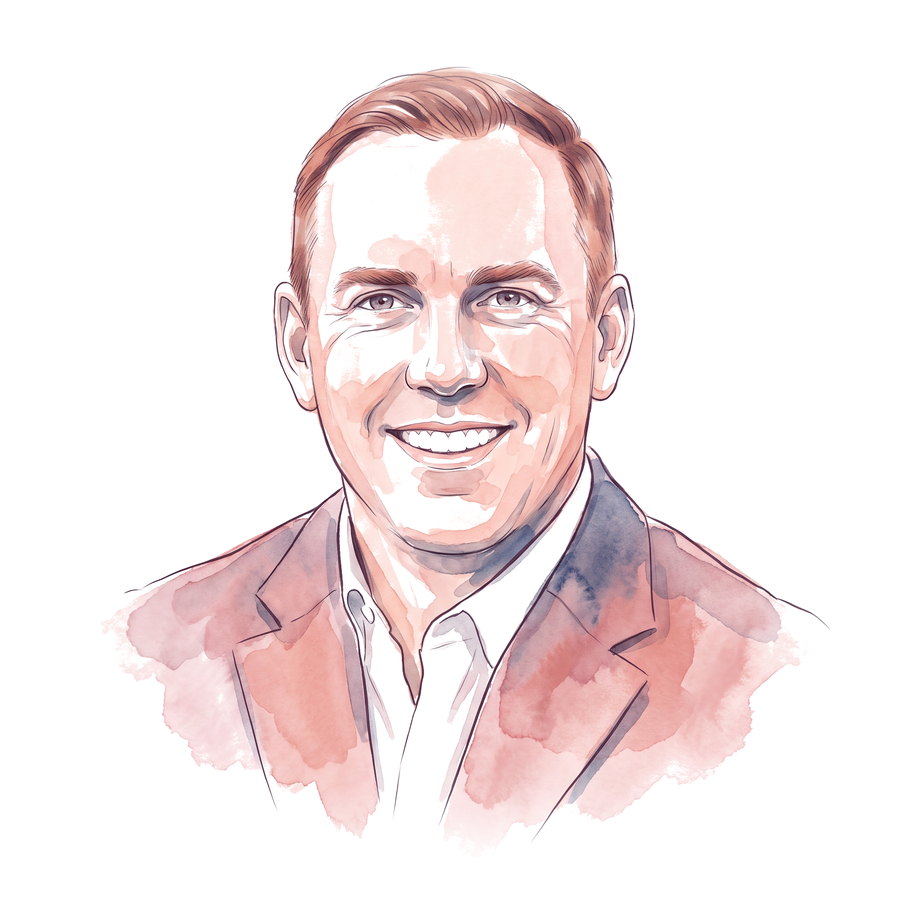
When Michael Semanchik started in innocence work, finding a client began with a phone call to Sacramento. The service was called Inmate Locator. California held about 220,000 people in its prisons then, he says, and moved them constantly; men slept in triple bunks in gymnasiums built for basketball. To find one you needed his prison number or his date of birth, and you could ask about three people per call. You sat on hold for forty-five minutes. When the operator picked up, “you’d have to be ready with your 3 names, your 3 dates of birth. If you weren’t, she’d hang up on you.”
There is a photograph from those years of a colleague, Nick Hill, with the office phone taped to the hood of his sweatshirt so he could keep typing while he waited. Semanchik remembers thinking it was the most inefficient system that could possibly exist. Around 2011 or 2012 the state put the locator online, and the forty-five minutes became a search box.

He tells the story for what came after it. There have been hundreds of improvements like that over the past twenty years, he says, and he believes the one arriving now is bigger than the internet was. Semanchik is the executive director of The Innocence Center, a nonprofit law firm in San Diego that works to free people who were wrongly convicted. When I ask what gets him up in the morning, I expect a case. He names the tools instead. “If we can do more with the same amount of resources we have now, then that’s great.”
I know what more looks like, because he showed me once. Mike has been my friend for more than a decade, and in 2016 he got me a press credential for a Riverside County courtroom on the day a judge would rule on Kimberly Long, a client of his, who had been sentenced to life for a murder she did not commit. I sat in the jury box with the rest of the press, a Dateline crew beside me, my camera up. She sat at the defense table in blue jail scrubs.
When the judge said it, her hand went to her chest, and I took the photograph: the second a person finds out she is walking out. It ran in the San Diego Union-Tribune. It remains one of the most valuable moments of my life, and it is what I picture whenever he says “resources.”

The work has always started with paper. Bankers boxes of it once, and now hundreds of PDFs that have to be read before anyone knows what happened in a case. “When I started in this work, you would read every single page in a case file,” he says. “That’s how you would start to learn about a case.”
He no longer thinks that is where to begin. Put the whole file through a legal AI tool first, he says, and have it lay out what was presented at trial and what was not, what is known now that was not known then, where the new evidence is. Then ask it the question his field spent decades learning to ask: “What are some of the red flags?” The lawyers still read. They just start in the right place.

He is particular about where the file goes. A case file is full of confidential material, so his office works in legal AI tools built for law firms, not ChatGPT or Claude. Protecting that data is a real concern, and his team treats it as part of the work.
It is already in his courtroom. At a hearing in September, witnesses testified whose earlier interviews his team had recorded and run through an AI transcription service. When one said something that did not match, he searched for the words, hit play, and had the impeachment evidence in front of the witness while they were still on the stand. “Took 5 seconds,” he says. The old way was a lunch break spent hoping to find it.
“It’s not pretty good if we’re taking people’s freedom away.”
The point of the speed is the queue. “We’ve had an endless number of people reaching out asking for assistance for eternity,” he says. The office has about 80 cases open. If the tools let it move through those far faster, the queue could be cleared, and new cases taken as they arrive, with the same staff the office has always had.
He has done the arithmetic on why that matters. One study, he says, found that 4.1 percent of death sentences were wrongful convictions, and death cases get the best of everything: the best judges, prosecutors, investigators, experts and defense attorneys. Most felony cases get whatever is available. “So the error rate might be closer to 6%, maybe it’s upwards of 10%.” Ninety percent sounds fine, he says, until you count what the other ten costs, including the true perpetrator who goes on to commit other crimes while the wrong person sits in prison.
Ask him for the case that stays with him and he goes back to 1986. A brutal murder in South Central Los Angeles. His client had a record, but nothing in it resembled this. He went to prison around 1988. Semanchik picked up the file around 2010 or 2012 and asked for DNA testing. “There should have been a ton of DNA,” he says. “Searched everywhere.” Los Angeles had destroyed the evidence in the early nineties.
His own investigation pointed to a serial killer on death row at San Quentin. “Went and interviewed him. The guy didn’t remember whether he had done this one.” Then the file closed itself. “The client ends up passing away in prison. And that’s the end of the case for me.”
“We didn’t know what we didn’t know.”
What he carries is not only the loss. Nobody in the eighties and nineties understood that everything should have been saved, he says, and the lesson he draws from it points forward rather than back. “If there’s some world in which we’re going to be living in 10 years and there’s something we should save or we should do, think about now, then we should try to think about that now.” He will not pretend to know what that is, for the cases or for the AI.
What he can picture is the pipeline run forward. A trial recorded and transcribed as it happens, the issues flagged as they unfold. “The jury comes back with their verdict and they say guilty. Instantaneously you go, well, here’s 10 red flags.”
He keeps the other ledger just as carefully. Automated license plate readers have, by his count, led to about 29 arrests of the wrong driver, one of whom spent a month in jail over a P read as an L. Facial recognition, he thinks, is up to about 15 wrongful arrests. He calls the technology a net positive, by and large, and leaves it there. It still gets things wrong. It is “overly confident to the point it shouldn’t be,” and it cannot find a witness or run a DNA test. “It can help us do a lot of the things, but it can’t do all the things.”
When I tell him this sounds like the most hopeful I have heard him, he objects to the premise. “I’m always hopeful, Joe,” he says. “Come on.” I should have known. Hope, for him, is not a mood. It is a count, and he has been keeping it since law school, when he heard Tim Atkins, who had spent 23 years in prison, say there were thousands more like him inside.
“I didn’t know that was even a thing,” Semanchik says. Exonerations made the news about once a month then. Now it is two or three a week. He has watched that number move for twenty years, one improvement at a time: a locator that went online, a file that can be read in an afternoon. The tools are not a new reason to hope. They are the next improvement, and the biggest one.
I ask what we missed. He brings up the fear everyone else brings up, that the machines take the jobs, and answers it with the only measure he has ever used. “If it took my job away and I had to go do something else, I don’t know that that’d be a bad thing,” he says. “If it means that there’s no more innocent people in prison, then haven’t we all won?”