
The man in charge of keeping AI safe at Anthropic said this month that he puts the odds of AI killing all of us inside the decade at better than ten percent. The conversation has changed pitch since. Slow down, pause, stop: those are the words in the air right now, and underneath them is a lot of plain fear and, honestly, even more confusion. I see it in the news every morning. I see it every Sunday when some of you hit reply. Nobody seems sure what the number means, or what a person is supposed to do about it on a Tuesday.
So I went looking for somebody to talk it through with, and I could only think of one person. You may love him. You may find him incredibly corny. Plenty of people manage both. A good friend of mine got me the interview, and I’m more thankful than he knows. You know who you are! The boot room at Nelson Road, a Tuesday after training, Coach Beard in the corner. I read him the quote before I said hello.
The interview
JOEI want to start with a quote. The man who runs alignment science at Anthropic said publicly this month that he puts it at better than a ten percent chance AI kills every human being inside the decade. One of his researchers had just resigned saying the industry is gambling with our lives.
TEDBoy, you come out of the gate, don’t you. No “how was your weekend.” Straight to the extinction of the species.
JOEHow was your weekend?
TEDIt was lovely, thank you for asking, we lost.
JOESo. Reaction.
TEDAlright. Well, first off, I’m gonna say something that might get me in trouble with the folks who like me. I believe him.
JOEThat’s not what I expected.
TEDI know it. Folks hear my accent and they figure I’m gonna say it’ll all work out, and that’s not belief, Joe, that’s weather reporting. A fella whose whole job is to look at the thing he helped build and tell you the honest bad news about it? I don’t know how to hear that and call him a pessimist. That’s the most expensive kind of honest there is. Man’s got a mortgage and he said it anyway.
JOEHow do you sit with a number like that?
TEDSame way I sat with sirens.
JOESirens.
TEDI’m from Kansas. You grow up with a siren on a pole, and once a month it goes off on a Wednesday for practice and everybody keeps eatin’ their lunch, and then one night it goes off on a Tuesday and it ain’t practice. There was a woman on our street, Arlene Tiller, kept a suitcase by the basement stairs the thirty-some years I knew her. Wedding album, some papers, a can opener, and a flashlight she checked on the first of the month.
JOEDid she ever use it?
TEDNot once. That can opener never met a can. Died at ninety-one, suitcase packed. And folks always think the joke’s on Arlene. It ain’t. She was the sanest person on that street. She’d done her math, she’d built her basement, and then — and this is the part — she went and had a life up on the ground floor. The suitcase didn’t get a vote on her Tuesday.
JOEWere you ever actually down there?
TEDCouple times. One night my mom and I sat in the crawlspace playin’ gin rummy while somethin’ went over the top of us, and I remember being more mad about losing than I was scared.
JOEWho won?
TEDShe cheated.
JOEThat’s not an answer.
TEDShe cheated, Joe. And there was a family on that street moved to Missouri on account of the odds, and I never once thought that was dumb. I just couldn’t have done it and still been me. Your ten percent is a tornado you can’t move to Missouri to get away from. So all that’s left is: do you build the basement, and then do you go back upstairs and play the gin.

JOEThere’s real despair out there right now. A friend of mine called me a while back and told me we’re all finished. Smart guy. Not a crank.
TEDYeah. I got a version of that fella in my phone too. Mine texts at two in the morning and then sends a link. Here’s my one pushback. There’s a difference between an alarm and a eulogy, and folks have started reading the one like it’s the other. An alarm says do something. That researcher who quit his job? That’s a fire alarm. I have never in my life been mad at a fire alarm. A eulogy says it’s done, sit down. And I notice a whole lot of folks pick up the alarm and set down a eulogy, and use the first one to justify the second, and I don’t think that’s honest. I think that’s tired.
JOEIsn’t that a little easy, coming from a man whose actual job is morale?
TEDOh, it’s extremely easy coming from me. I get paid to be like this, Joe. Nobody’s cutting my check to walk in Monday and go, y’all, the underlying trend is not favorable. So squint away. But I’d say the same thing if I got paid nothing, which I can prove, ’cause I said it for eleven years coaching a high school team in a town with one traffic light and I made four thousand dollars a year and a ham at Christmas. A specific ham, from a specific guy. I have thoughts about that ham I’ll spare you.
His sport publishes the odds of your own catastrophe every week, on a chart, next to the weather. I asked whether it maps.
TEDMostly. But there’s a place where it don’t. In my trade, if the chart says we’ve got a ten percent chance of goin’ down, nobody in this building is confused about what happens Monday. Beard’s got the set pieces. Will’s got the kit. I’ve got the room. You can be terrified and still know exactly who you’re marking. I read your fella’s ten percent and I cannot tell who’s marking who. That’s what unsettles me. Not the odds. The lack of assignments.
Hang on, I want to turn that around on you. Who’s marking who on your end?
JOEHonestly? I don’t know. I write a newsletter.
TEDThat’s an assignment.
JOEIt’s a small one.
TEDThey’re all small, Joe, that’s what an assignment is. Nobody gets handed the whole pitch.
His first honest question to one of these things, he told me, was its favorite sandwich. It said it doesn’t eat; he said he knew that and was asking anyway. It picked a Reuben — “a bold answer, that’s a sandwich with enemies.” Near the end he asked if I was scared, and what I do on the days I am, and I told him something I’d never said out loud.
JOEYears ago I worked at a company that was going under, and I got up at a town hall and held up a sign I’d made. It said BELIEVE.
TED[laughing] Get out.
JOEBig yellow thing.
TEDDid it work?
JOEHalf the room loved it. Some of them hated me for it. And then I left, and somebody had to take it down, and I never found out who.
TED[pause] Well. Somebody carried that sign to a bin. And somebody else read it every morning until they did. You don’t get to know which one of those mattered more. That’s the whole deal, brother. You put the thing up anyway and then you don’t get the receipt.
JOEAre you optimistic?
TEDNot about the machine, no. I don’t know enough about the machine to be anything about it, and I’d be suspicious of a football coach who did. I’m optimistic about the room. I’ve spent my whole working life watchin’ what people do when the scoreboard says they’re finished. Plenty go home, and I don’t hold it against a single one of ’em. But every time — every time, Joe — there’s five or six who go the other way. Get strangely calm. Start helpin’. That number has never once been zero in twenty-some years. And you hand me a ten percent chance everything ends, what I hear underneath it is a ninety percent chance a whole lot of people are gonna need somebody steady, and I’d like to be in the building for that either way.
A note, before the sign-off: the interview above is fiction. Ted Lasso is a character created by Jason Sudeikis, Bill Lawrence, Brendan Hunt and Joe Kelly, no call took place, and my friend in the business would like that on the record. The ten percent is real.
I’ve been carrying “the lack of assignments” around since. It’s the truest thing anybody has said to me about this year, and I had to make somebody up to hear it.
Mine’s small. I write this essay. You read it, and some of you write back, and that’s the whole pitch I’ve been handed. I’ll take it.
— Joe

From the Workbench
The line I can’t shake is the lack of assignments — everybody terrified, nobody sure who’s marking who. This field guide is the closest thing I have to a fix: a culture of AI isn’t a policy, it’s how your people talk about the tools, and there’s a way to tell whether yours is working.
The Constellation · Apocrypha

This week’s star doesn’t exist, which is a first for the chart. The full interview — the two a.m. question he won’t repeat, Coach Beard on Neal Stephenson, and a second call where he assigned me a science-fiction contest — is on the site, in the form the real profiles take.
Mostly Working
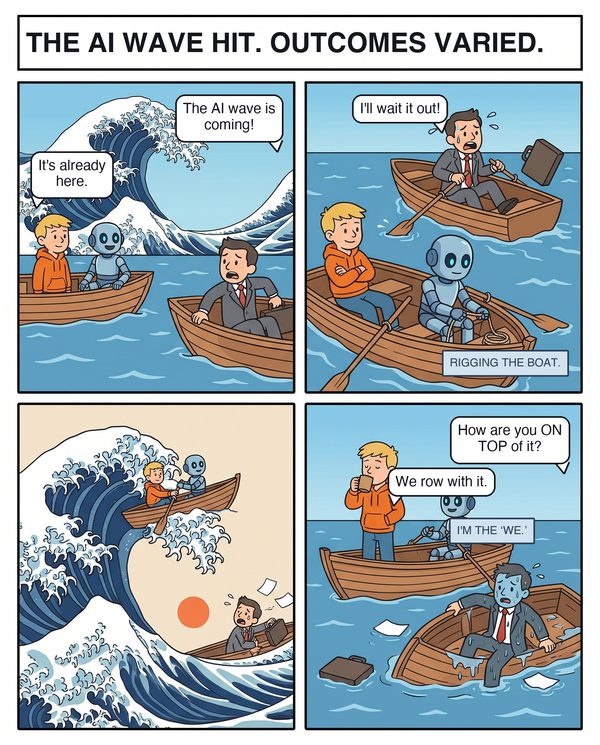
No. 19 is the one Ted would draw: the wave comes for two boats, one man rows away and the other one rigs his. Build the basement, then go play the gin.
