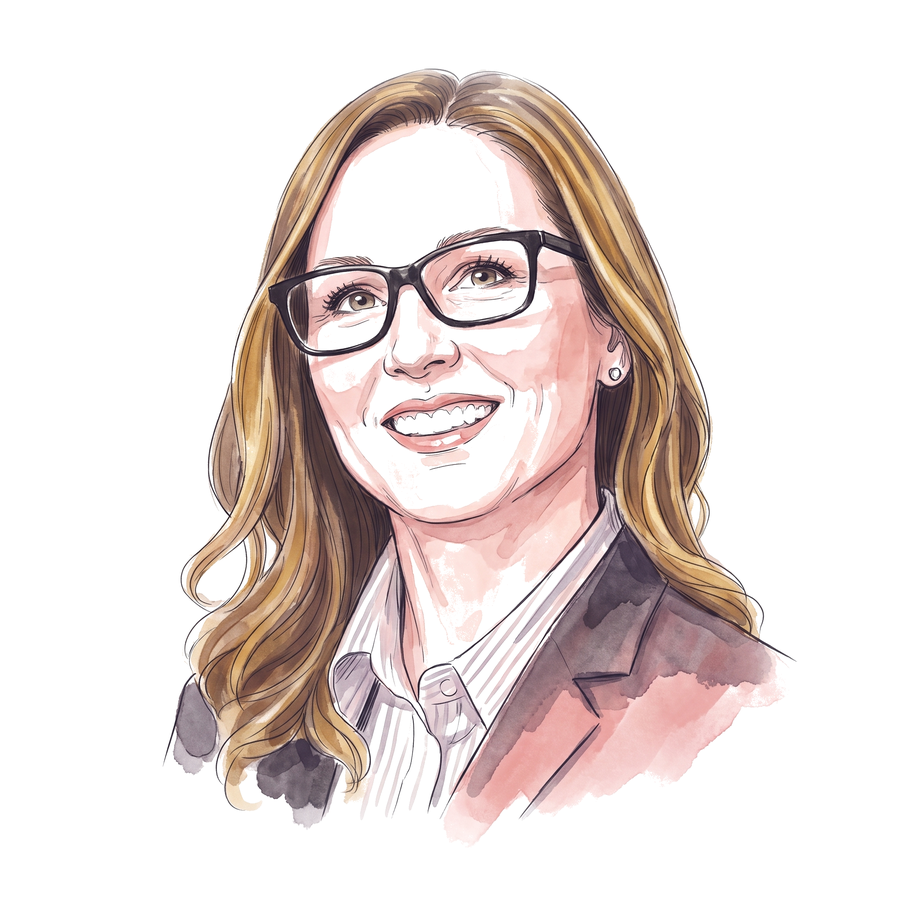
Some days in the 1980s, Kelly Crabb went to work with her father. He delivered truck parts around Chicago, engines among them, and the route ran through some of the city’s rougher neighborhoods and into yards she remembers as junkyards, the kind with a dog on a chain. He took out a different truck depending on the load, and she remembers the smell of diesel.
She remembers the welcome better. “Right away people would stop what they were doing and were so excited and happy to see him,” she says. “And by default were happy to see me. Nobody questioned why I was there.” She was there, she figures, because her mother had to work too. A taco run usually followed.

Her father had started the business after several layoffs. He worked as a broker: trucking companies needed parts that were hard to find, and he knew where to find them. “He built trust and he was dependable,” Crabb says. “He followed through and did what he said he was going to do.” Her mother worked administrative jobs, sometimes more than one at a time. She had gone to work at seventeen, after her own father died, to stay near her mother and bring money home. Crabb’s father had gone through school with reading challenges nobody tested for, and he got help for them only as an adult. Neither parent went to college.
Crabb was the first. She “tripped over all of the invisible sticks of the things that I didn’t know that I didn’t know,” she says. At the University of Iowa she carried five classes and managed two bars. “I could be shutting down the bar at 3 a.m. and going off to student teach by 6 a.m.,” she says. Her first job in higher education was as a college admissions rep, helping other people down the path that had tripped her.
She kept one lesson from the truck. “I understood quickly that his success was 100 percent contingent on those relationships,” she says. She built a career in sales and defends the word. “To me, it’s being able to listen and understand people, the problems they are communicating and the ability to bring a solution,” she says, “and it’s about being a giver, and someone who helps make something better than the way they found it.”
The other inheritance was the load. “I think I was conditioned with work harder, do more, carry more,” she says. “It can become exhausting, because you’re always trying to take on more and do more and demonstrate your value through doing more.” I ask if there was a time when she knew she had to rethink it. “There’s so many,” she says.
“Every time I think I outgrow it, I revert back to it.”
Her correction is to distrust the first diagnosis. When someone brings her a problem, she says, she is “a lot less interested” in how quickly she can solve it than in “asking the deeper questions around, are we even solving the right problem?” The habit matters more now, she says, “because answers are getting cheaper and faster.”
At one company where she led global sales, the business sold assessment tools one department at a time, to a nursing program or a law school. Then the team saw that the trouble with assessment data and integrity belonged to the whole institution. “It changed who we were talking to. It changed the messaging. It changed things within the product,” she says. “We were just sort of myopic initially.”
Sales lists get the same treatment. She remembers the spreadsheets that counted every account in a territory as addressable market and sent the whole team to call them. “What if only 5 percent of the people on that list actually have a readiness for your product offering or a propensity to buy?” she says. Finding that 5 percent, she says, is something AI can help with, by “flashing the green light.” The conversations that follow stay human.

Most organizations, she says, treat AI as a tool for doing the same tasks faster. Her question is how to redesign the work. I ask whether AI would have freed her parents from the grind. “It has the capability to free all of us up out of that grind,” she says. “But I think without properly designing the work, it will just sort of accelerate the way that we are doing things.”
“It’s just a different way of doing more of the same things.”
Crabb is testing the idea on herself. As she thinks about what she wants to build next, she isn’t starting with a job title. “Folks keep asking me what’s next, and I don’t answer with a job title,” she says. “I’m thinking about what problems that I want to solve.” She sorts a growth executive’s job by asking where technology can increasingly augment or automate the work, and where human judgment, relationships, creativity and synthesis remain essential. Building teams, seeing a market and brokering the partnership are “very human-heavy,” she says, “because it requires listening and understanding an organization’s problems and building relationships.”
She sums up the work she wants next in five verbs: “see, connect, create, commercialize and scale.” The first two she watched from her father’s truck. She has added a test. She wants her teams and her partners “to feel like, okay, that just made my life a little easier.” The people in those Chicago yards stopped working when her father walked in for the same reason.