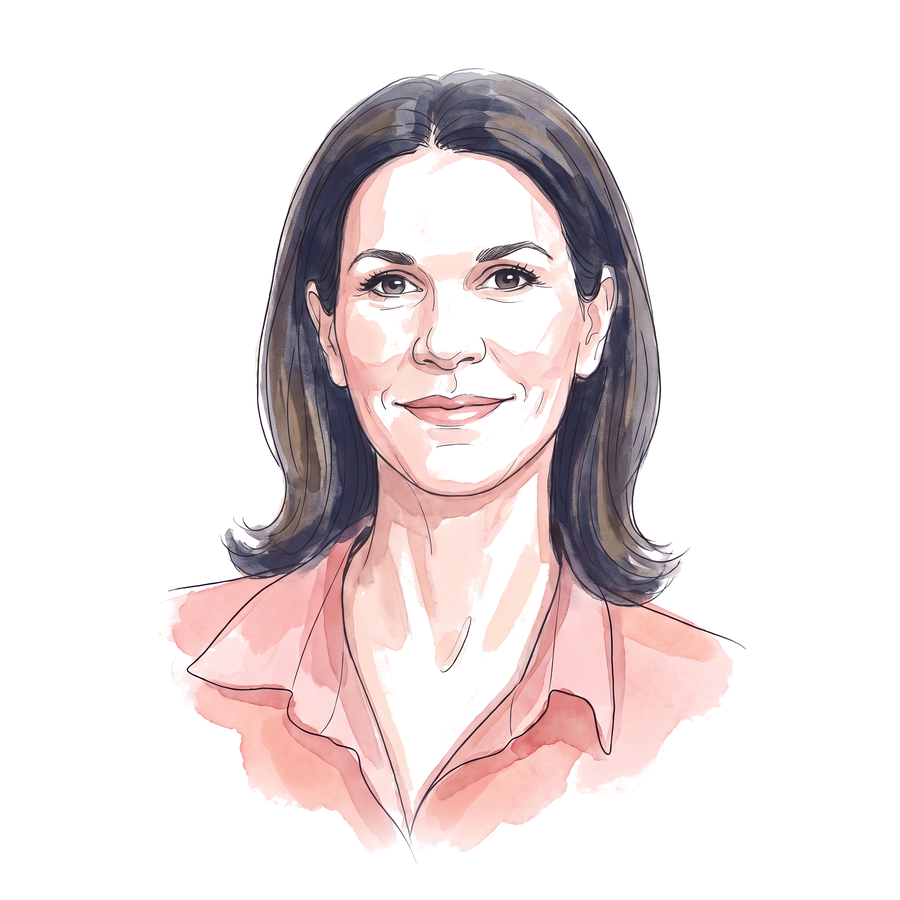
Nicole Brownell does not walk into a company without providing clarity on why. “We’ve got some performance needs and opportunities to harness,” she says, rehearsing the speech she gives leaders on day one. “I know that they’re keeping you up at night. Share with me what’s really going on. I’m here to help create options for you.”
Then she turns the light on everything. She interviews the team, holds every department and activity up against the profit-and-loss statement, and installs trackers and scorecards where there are none. “That’s how we surface what’s been hiding in the dark,” she says.
Her last CEO, at a Salt Lake City data company where Brownell served as chief operating officer, gave the method its name. She told the team that Nicole would come in with a flashlight and shine it on every area that could be improved. Brownell had already shown her the results first. “I have deep pattern recognition,” she says. “I can typically tell you what’s wrong before we even know what’s wrong. I do things in the light. I don’t do things in the dark.”
“Let’s just name it. I’m a New Yorker, for goodness’ sake, so we don’t talk about things or people behind closed doors.”
Executives in the companies she works in call her the wolf, after the fixer in Pulp Fiction. “At first it bothered me because it felt cutthroat,” she says. “But now I’m like, I’ll own that.”
Today she leads the technology and commercial arm for the value creation practice at Novo Advisors, a Chicago and New York based advisory firm. Private-equity firms and lenders bring her into companies that are at growth moments or are underperforming. She walks into every department with her team, finds the loose connections and writes the plan, then usually stays to carry it out, often as interim CEO, board or executive advisor. More likely the technology is fine and it’s the company that is not working as one system. “If you think about a bike,” she says, “the pedals are separate from the chain.” With a flashlight-type method, everything outside the beam is what the company stopped looking at.

Brownell’s ability to recognize patterns began long before her career. She grew up in New York. Her parents divorced when she was very young, and her childhood unfolded between two very different worlds. Upstate, where her father lived, life was polished. Her paternal grandfather was one of the early leaders of New York Telephone, and Sundays were spent at the country club. In the city, and eventually in Brooklyn, she first lived with her maternal grandparents, who helped provide stability as her mother struggled with addiction. “Slowly and then suddenly,” Brownell says of how it took hold. Over time, the circumstances became increasingly difficult to navigate.
“You knew what to walk around, when to open your mouth, when not to,” she says. A child in that environment learns when to speak and when to disappear. “There’d be points where I’d be five years old, six years old, and basically have to figure out how to get myself to school or I would just fully be taking care of myself,” she says. Those years taught her to read situations and adapt to the circumstances around her. Her instincts, paired with data and professional experience, became central to how she approaches business and leadership.
Her father remained a strong presence in her life, and at eight she eventually relocated upstate to live full-time with him and his nearby family. Her grandfather saw what she had learned and gave it somewhere to go. He sat her on his lap with the financial pages of the Times, back when the stock tables ran in the paper, and taught her to read them. “He taught me about investing, saving, business, decision-making,” she says, and to use the pattern recognition skills he could see her developing “for business and for accelerating myself.” He also taught her that she was the only person responsible for herself.
She has no anger, she says. “They did the best that they could do with what they were given and what they had.” Her mother for years oscillated between her addiction and sobriety and died in August 2018. Her relationship with her father remains close, built on a connection that runs deep.
The skills were in her work long before that. The confidence was not. As a woman in technology, “you have to work differently and be a little quieter,” she says, so she did not say it out loud. She was packaged instead as the new-business person, the ad-agency person, the builder of organizations.
In the months after her mother died, other hard things landed too, and she kept moving. She noticed. She was at her home in Florida, on her lanai, thinking about Jim Collins’s hedgehog from Good to Great, the one thing you do better than anyone else. “I think I might have my hedgehog,” she remembers thinking. “I just might not be packaging myself right.” “That entire person is a fixer,” she says. “It’s an operator.” Grief changed the math. “I don’t care anymore if you’re uncomfortable with my skill set. I’m just going to be me.”

Owning the skill has not made it lighter. A company that threw people at a problem does not need those people once the problem is solved. “That’s the stuff that keeps me up at night,” she says. Her answer is to try to put herself out of business. “Analyze the problem,” she says. “Fix it first and then apply people if you need them to scale.”
“Humanless technology is useless. It has to have breath to it.”
The drumbeat she arrived with is that connection is what makes technology work. Structured data comes in through observation. The magic, she says, is a human mind reading sentiment and watching, the unstructured data. “That’s where I could read your face and tell, are you telling me the truth? And the machine cannot do that.”
She wants companies to get good enough at the early decisions that nobody has to send for her. “Create situations,” she says, “where people like me don’t exist anymore.” The reading of faces she keeps.