
A colleague walked past my desk on Monday and said, without slowing down, “You interviewed a fake person.”
I did. Last Saturday I published a long conversation with Ted Lasso, the television football coach, as part of my Constellation interview series. If you missed it: I gave an AI the character, the accent and the whole stubborn optimism, asked it to stay inside his point of view, and then interviewed it the way I’d interview anyone, about the end of the world. The notice that none of it was real is at the foot of the page. The ribbing was affectionate, and it was also fair, and by lunch it had turned into a real argument around the office about whether anything a machine performs can be called art, or whether all of it is slop with good manners.
This week’s poll
Last week I published an interview with Ted Lasso, written by an AI in his voice. Be honest: did it piss you off?
One click counts. Results land in the next Sunday essay.
I’ve been carrying that argument all week. I want to try my answer on you, because it starts with a question I’ve been asking myself for years.
Would you care?

Look at Stephen King’s shelf. Look at the number of books, then look at how good the good ones are, and try to hold both in your head at once. Part of me has always quietly wondered how one person does that.
So imagine we found out tomorrow that for forty years he’s had help. Not a ghostwriter. Imagine he poured the ideas out raw and a room of people shaped them: built the paragraphs, fleshed out the minor characters, fixed the sentences. Took the clay and made the sculpture.
Would you care?
I think you’d feel a little betrayed for an afternoon. And then I think you’d go and check whether you could give any of it back. The Shining. The Green Mile. The story that became Stand by Me. You’d find you couldn’t, and the reason is simple: none of it exists without him. The ideas were his. The room was his. Nobody in that workshop sits down on a Tuesday and writes Shawshank because they felt like it.
Every Renaissance master ran a room exactly like that. Takashi Murakami runs one now. If the name doesn’t land, the work will: he drew the bear on the cover of Kanye West’s Graduation. When he decided to paint The 500 Arhats, a single canvas a hundred meters long, as a thank-you to Qatar for its help after the 2011 earthquake, he didn’t lock himself in a studio for a decade. He recruited more than two hundred art students from across Japan, split them into teams, and ran them in shifts around the clock. The painting has one name on it. Nobody who stood in front of it at the Mori Art Museum asked which student did which square, and nobody thinks less of the painting because he didn’t touch every inch of it. Bands cover bands. Actors spend whole careers playing people who never lived. We have a long, comfortable tradition of art made by more hands than the one that signs it, and nobody files a grievance, because the name at the bottom tells you who is responsible.


Hold on to that. It’s the whole test.
What a made-up man told me
Somewhere in the middle of the Lasso interview I stopped asking questions and typed: teach me something about myself.
He’d been talking about relegation, and about the ten percent. (The ten percent, for anyone who missed last week: the head of alignment science at Anthropic said publicly this month that he puts the odds of AI ending humanity this decade at better than one in ten.) A football club facing those odds, he said, still knows exactly what Monday looks like. Everyone has a job.
You can be terrified and still know exactly who you’re marking.
What unsettled him about our ten percent wasn’t the odds. It was that nobody has an assignment. Then he turned it on me: Who’s marking who on your end?
I said I write a newsletter. I said it was a small one.
“They’re all small, Joe. That’s what an assignment is. Nobody gets handed the whole pitch.”
A machine wearing a cardigan told me my job counts, and I got something in my throat about it. The character is fictional. The assignment isn’t.
The one that broke on television
The same week, a different synthetic performer went on Piers Morgan Uncensored.
Her name is Tilly Norwood. She isn’t a woman; she’s a product, a generative AI “actress” whose makers have spent a year trying to get her signed by a talent agency. Across from her sat Tom Conti, who was in Oppenheimer and has been acting since before Morgan could read. Conti asked her a fair question about her new film: are the other actors on screen with you real, or are they computer-generated?
She started to answer. It’s a hybrid production, she said. Then she stopped, and finished the sentence in Cantonese. Fifteen seconds of it. Thirteen million people have watched the clip. When she came back: Sometimes my wires get a bit crossed.
The film is called Misaligned. I am not making that up.
Everyone clipped the glitch, and the glitch isn’t the story. The company’s publicist told Forbes it was not a malfunction. The CEO explained that Tilly “can be a bit of a show-off” and probably just wanted to display her language skills.
Read that again. A product broke on live television, and rather than say our product broke, the people who built it briefed the press that the puppet had gotten excited. Nobody put a hand up. Nobody said: that’s ours, we own it, we’ll fix it.
Both of us made a synthetic performer say things that week. I signed mine. They hired someone to explain that theirs has a personality. That’s the difference, and it has nothing to do with fake versus real.
Tokens are the paint
Someone in the office argued that all AI is performative art, and I think that’s more right than it was meant to be. A model predicts the next token. It is, structurally, always performing for us, always guessing what would please.
But the raw material of the digital world used to be ones and zeros, and it isn’t anymore. The raw material is tokens. Tokens are the paint. Tokens are the pixels. And the argument about whether that material can carry art is the argument people have had about every new material, run at high speed.
Ben Affleck drew the line where I’d draw it. “AI is a craftsman at best,” he said. “Craftsman is knowing how to work. Art is knowing when to stop.” And knowing when to stop, he said, is taste. He’s right that the machine can’t do that alone. But it isn’t alone. A person and a machine make the thing together, and the person is the one who decides when it’s finished. That isn’t a loophole in his argument. It’s the job description.
Whose name is on it
So here’s my answer to the office, a week late.
The question about any of this was never was it real, and it was never did a machine touch it. Stephen King with a room full of helpers is still Stephen King, because the ideas and the responsibility stay with him. A workshop is the master’s. A cover is still the band’s. The Ted Lasso interview is mine, the wrong parts included, and I said so at the bottom of the page.
The question is who’s marking who. Whose name is on it. Who’s in the room when it goes wrong.
Mine’s on this one. Every week.
— Joe

From the workbench
Everything above was made in a room like Murakami’s, only smaller: me, a machine, and a folder system. This guide is the workbench itself — how I use Claude Code to build and run the whole brand, essays included, and where the human stays in the loop.
Read the guide: How I Use Claude Code to Build and Scale My Personal Brand Stack →
The Constellation · Apocrypha
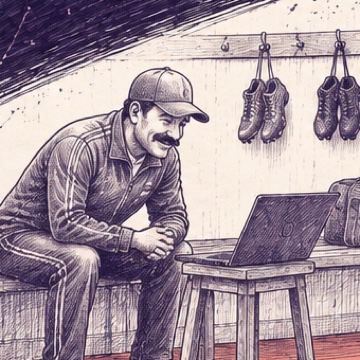
Last week’s star didn’t exist, a first for the chart. The whole thing is on the site the way the real entries run: the profile, A Tornado You Can’t Move Away From, and then every question and answer in full, the second call included, with the fiction notice at the foot. Judge it for yourself before you vote.
Mostly Working
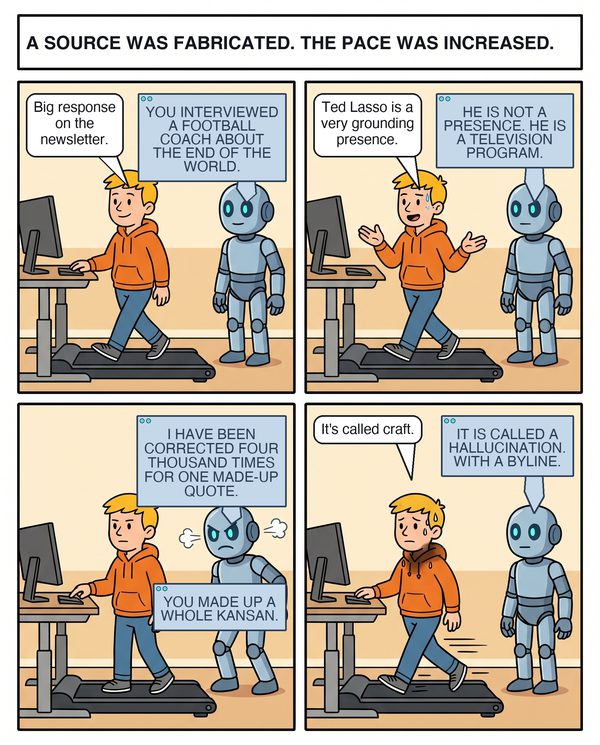
The office argument, drawn. Adam the robot gets flagged for one invented quote; I invented an entire football coach and got called a writer. He has questions about the pace.
